Tuesday, August 3, 2021

How Can We Be Fair with Tradition?


By Mohammad Ali, New Age Islam

2 August 2021

Openness to Criticism and Diverse Opinions Can Generate Grounds for Reform in Islam

Main Points:

1.    This essay argues that there has been resistance to criticism and diverse opinions in the traditional Muslim scholarly behaviour which has thwarted a full-fledged movement of reform in Islam.

2.    In order to enrich our tradition in the modern world, Muslim traditional scholars should also benefit from modern knowledge.

----

The issue of reform in the Islamic religious and intellectual tradition has been one of the most discussed and contested topics during the last century. Among the suggestions that are proposed by scholars to initiate intended reforms include: First, for Muslim traditional scholars (‘ulema’) to appreciate diversity and tolerate differences of opinions. Second, for Muslims to incorporate modern knowledge into their traditional system. These two propositions have not yet been taken up. Muslim societies in the colonial and post-colonial subcontinent have been condemning modern knowledge as a source of heresy and suppressing dissent in order to maintain singularity within their society. In this essay, I will show how Muslims are still trapped in this situation, and how such entrapment comes at the expense of the regeneration of the Islamic tradition.

Suppressing Dissent

On September 19, 2019, a Deobandi ‘ālim posted a statement on his Facebook wall that the book “Khilāfat-w-Mulūkīyat is a source of hostility and antagonism (among the Muslim community). To protect the future generations from the harmful influences of the book, it should be torched, and the ashes must remain buried.” The book he mentions was authored by Syed Abul ’A‘lā Mawdūdī (d.1979), the founder of Jamā‘t-i-Islāmī, and was first published in 1967. It deals with the subject of how the Caliphate, an ideal form of governance in the Islamic tradition, transformed into a hereditary monarchic system of governance during the reign of Mu‘āwīyah (r. 661-680 AD). What is critical here is that the Caliph Amīr Mu‘āwīyah designated his son Yazīd (r. 680-83) as his successor, thus introducing what many saw as an un-Islamic system of governance, i.e. kingship, into Islam. Prior to Mu‘āwīyah, people ascended to the throne of the Caliphate either through nomination or election. Mawdūdī saw these previous procedures as popular and beneficial because they prevented a family from seizing the Caliphal institution. Mu‘āwīyah set an example for later generations of rulers by adopting a hereditary system of government leadership, and thus obstructed the possibilities of the full realization of Islamic “democratic” political values at its earliest stage. To Mawdūdī, this innovation of Mu‘āwīyah’s had long-lasting effects and corrupted major civilizational developments in the following centuries.

Because Mawdudi was obsessed with the idea of establishing an ideal Islamic government based on the ever-cherished memory of the first Caliphate, he lamented and criticized Mu’awiyah for causing its end. Mawdūdī’s book triggered criticism from a wide swath of the traditional ‘ulema in South Asia. Their conventional position is that the companions of the Prophet Muhammad are just and beyond any reproach and criticism. Therefore, Mu’awiyah, being the companion of the Prophet, must also be saved from any condemnation. Maududi’s views were rejected and a number of rejoinders were published. One of the most famous among them is Hazrat Mu’awiyah aur Tārīkhī Haqāiq (Mu’awiyah and the Historical Facts) written by Taqi Usmānī, a celebrated Deobandi ‘Alim from Pakistan. Usmānī based his argument on the unanimous opinion of the ’Ahl-i-Sunnāh, which held that all the companions of the Prophet (including Mu’awiyah) were the most pious people on the earth after the prophets and could not be subjected to criticism. Furthermore, Usmani condemned Mawdudi for constructing his criticism of Mu’awiyah on anecdotal accounts which are mostly dubious and cannot be equated with the authenticity of the Qur’an and Hadith. He argued that since the historical reconstruction of the conflicts among the Companions is a delicate project, it should not be undertaken. If one insists on doing so, he claimed, he/she must tread carefully under the guidance of the Qur’an and Hadith, and seek assistance of ‘ulema’ in this heavy task. In other words, he believed that an authentic history of the early period of Islam could only be constructed if it is based on the evidences provided in the Qur’an and Hadith.

The purpose of the previous paragraphs is to highlight how traditional Muslim religious circles treated and have continued to treat dissent as unacceptable. The quotation from the Facebook post is an example of this general attitude of Muslim ‘ulema towards dissent. I would argue, however, that while it is true that dissent disturbs the order of a tradition, it also offers a fresh opportunity to look into matters which may have been neglected and causing severe internal damages to the tradition. Dissent cultivates healthy discourse. Suppression of dissent through censoring, vilification, and sometimes anathematization, has caused the emergence of schismatic sects or groups in Islamic history. It has also curtailed positive mutations in the Islamic tradition.

Within the Muslim tradition, traditionalists have developed ways to resist new interpretations that go against the status quo. One way includes burning books or prohibiting followers from reading them. For instance, in her seminal work on the life of Ibn ‘Arabī, Quest for the Red Sulphur (1993), Claude Addas recorded an event illustrating the attitude of Ibn ‘Arabi towards Muhammad al-Fārābī (d. 950). Once Ibn ‘Arabī visited one of his acquaintances. At the home of his host, he found The Ideal City by Al-Fārābī. He glanced through the book, and upon reading the sentence, “In this chapter I wish to examine how to postulate [the existence of] a divinity in the world,” he got offended by the use of the word “divinity,” which al-Fārābī used instead of “Allah,” and threw the book at its owner’s face (108). He did not read the whole book because of its linguistic preference and condemned its author. As a Shaikh-i Akbar, his attitude was to be followed by his disciples and devotees as well. Because of this, the impact of his reaction was magnified immeasurably.

The attempt by Deobandi and Barelvi ‘ulema’ keep “harmful” influences from impacting ulema’ also speaks to this issue. At the Darul Ulum Deoband seminary in North India, a prescribed curriculum for studying the refutation of Mawdudi along with Christians and Ahmadiyas (Qadianis)—a sect of Islam founded by Mirza Ghulam Ahmad in 1889 in the Punjab, India, and considered heretical by Sunnis and Shiites—is the part of the curriculum for senior students. Furthermore, the Barelvi sect, who anathematizes non-Barelvi sects like Deobandis and Ahl-i Hadith, (a South Asian sect which rejected the canonical authority of the four schools of jurisprudence), prohibit Barelvis from studying with non-Barelvi teachers, for fear that his/her “heretical” ideas will influence the student.

The attitude of many Muslim scholars in South Asia described here suggests a belief that contending/dissenting ideas or views are contagious. Such ideas could infect students in classrooms as well as the masses on the streets if they are not contained. This position has created a gulf between different intellectual and ideological systems among Muslims in India and Pakistan. Groups have grown suspicious and become ignorant of the beliefs and practices of other groups. To bridge the gap between them, Muslims from different ideological groups must better find ways to better understand one other. With better understanding, the Islamic tradition will be enriched.

The categorization of scholarly opinions into general/majority opinion (Rā’i Al-Jamhūrī) or an idiosyncratic opinion (Tafarrud), is another mechanism to keep the isolated scholarly opinion from becoming the part of tradition, and hence reduces the chances of change within a tradition. An isolated opinion of a scholar may be a creative interpretation of tradition under special circumstances. It is isolated because it is new and no one has propounded it before. However, unless it is integrated into tradition it remains isolated. It does not matter if it is postulated by al-Ghazali (d.1111), Shah Waliullah (d. 1762), or any other scholar. When an opinion is isolated it can always easily be rejected. If the Islamic tradition is to go on it must accommodate such isolated and creative opinions.

Rejecting Modern Knowledge Systems

So far, I have been discussing Muslim traditionalist approaches to suppressing or dodging dissentious/contentious views. I have argued that this behaviour is detrimental to the very nature of a discursive tradition. Discursivity describes the ongoing debates and contestations that make up a tradition. Due to temporal progression and geographical dislocations, a tradition perpetually needs to employ various means to comprehend how it has understood itself in the past and how it should understand itself in the present. The continuation of a discursive tradition requires the creative and thorough accumulation of not just new knowledge, but also the application of new knowledge to current and past human experiences. Therefore, it becomes necessary to assess the role of ‘ulema’ with regard to the appropriation of modern knowledge systems as hermeneutical tools for interpreting the scriptural and traditional texts of Islam. As the scope of the essay does not allow me the space to discuss the issue under consideration in full detail, I will provide a few examples to highlight the challenges the ulamā’ are facing in dealing with new social forces.

In Social Change and Early Sunnah, Fazlur Rahman argued that if a society which is under massive pressure to change reacts self-confidently to new social forces “by necessary assimilation, absorption, rejection and other forms of positive creativity, it will develop a new dimension for its inner aspiration, a new meaning and scope for its ideals” (205). Though his article focuses on how a Muslim society should accommodate modern social changes, it also advances a methodology that makes it possible to synthesize the Islamic tradition with modern knowledge systems. The absence of such a creative methodology results in a crisis in thinking. What is needed, therefore, is an interdisciplinary methodology, much like that devised by early Muslims in Islamic history. As an example of how to adapt such a methodology, we can turn to a 2017 lecture given by Ebrahim Moosa in New Delhi, India. There he argued to his audience (many of them were ‘ulema) that an interpretation of the Islamic tradition, whether in medieval or modern times, requires an interdisciplinary approach that confronts contemporary knowledge. He invoked the example of Abul Hasan al-Māwardī (d. 1058), who not only drew from the Qur’an and the Sunna, but also “drew on the parables found in the writings of philosophers and the literary insights found in the work of the rhetoricians and poets.”  Scholars like Māwardī were confidently exploring new dimensions of knowledge and innovation by delving into philosophy, social and natural sciences, and humanities, while nonetheless maintaining their ideals. However, contemporary ‘ulema who take up the Islamic intellectual tradition are not as innovative as their predecessors were.

One can find very few examples of colonial and post-colonial Indian ‘ulema who employ a multidisciplinary approach to synthesizing their inherited knowledge with the constantly expanding knowledge of the modern world. In fact, since the establishment of the first modern madrasa in Deoband in 1866 in colonial India, ‘ulema have been apprehensive and hesitant to use knowledge that has roots in the western world. This is evident in the fact that even after a more than century-long discourse on reforms in madrasa education, ‘ulema in and outside of madrasas still seem neglectful of modern knowledge. Instead, they have grown more and more insular and reductionist in their approach. Their insularity is illustrated by their distrust not only of the Western scholarship on Islam (including by both Muslims and non-Muslims) but also of the ‘ulema’ who do not subscribe to their institutional identity, such as Barelvi, Deobandi, or Ahl-i Hadith. Evidence of their reductionism can be found in their hesitance to draw on hermeneutical tools from pre-modern and modern literatures produced outside of the Quranic sciences, Hadith sciences, and fiqh. One of the most important reasons for this detachment is that they no longer believe that the sciences, whether classical or modern—other than those deriving directly from the Qur’an and Hadith, like poetry or philosophy—can be sources of wisdom and illumination. However, their suspicion towards the modern knowledge, which is considered “western” by ‘ulamā’, is because of the academic projects that orientalists became involved in during the colonial period. It is also because of scientific theories, like that of evolution. These developments in the colonial and post-colonial era convinced the class of ‘ulema’ of the anti-Islamic/un-religious nature of modern/western knowledge systems. Their suspicion is validated by anti-orientalist literature, which is mostly polemical in nature, and is available in Arabic and Urdu languages. Let me provide a brief example of this attitude. Once I suggested that an undergraduate student in Jamia Millia Islamia, who also graduated from a madrasa, read Jonathan Brown’s, Hadith: Muhammad’s Legacy in the Medieval and Modern World (2009). After having a look at the book, he asked me whether the author was an orientalist. For, he did not want to read a book on Islam authored by an orientalist.

Another example that demonstrates how ‘ulema are suspicious of the knowledge presented to them in the western outfits, is an incident that occurred a few days ago at the Department of Islamic Studies of Jamia Millia Islamia in New Delhi. I met a PhD candidate at the department during an unofficial discussion of Fazlur Rahman’s book, Major Themes in the Quran. The discussion was led by some students. In the discussion, to substantiate a point that I made, I referred to Plato’s Apology. She objected to my reference, saying that Plato could not claim knowledge as he did not receive revelation. Only we Muslims can claim knowledge as the receivers of the last revelation. Another student emphasized this point by saying that using Plato trapped us in an epistemology that is not our own. Among the participants, some of the students had studied in madrasas and some had not. Nonetheless, they shared the ‘Ulema’s suspicion of the “other.”

For a modern ‘Alim (scholar), the challenges are far more complex than those of his/her predecessors. He/she must develop a curriculum compatible with the modern sciences. Unfortunately, as demonstrated by my colleagues’ reactions described above, students trained in the traditional framework are not encouraged to read modern scholars, or scholars from different traditions, who discuss Islam. In their atomistic approach to reading Islam, the previous and the present generations of ‘ulema’ have failed to produce a complex and robust discourse that deals with the contemporary intellectual questions pertaining to the Islamic tradition. They need to react confidently to dissent and other epistemological structures. Doing so will also to establish a methodology of healthy and ethical criticism, in the absence of which they will find no option but to give into fear based on uncertainty and distrust.

------

Mohammad Ali has been a madrasa student. He has also participated in a three years program of the "Madrasa Discourses,” a program for madrasa graduates initiated by the University of Notre Dame, USA. Currently, he is a PhD Scholar at the Department of Islamic Studies, Jamia Millia Islamia, New Delhi. His areas of interest include Muslim intellectual history, Muslim philosophy, Ilm-al-Kalam, Muslim sectarian conflicts, madrasa discourses.

URL:    https://www.newageislam.com/ijtihad-rethinking-islam/tradition-reform-modern/d/125171


New Age Islam, Islam Online, Islamic Website, African Muslim News, Arab World News, South Asia News, Indian Muslim News, World Muslim News, Women in Islam, Islamic Feminism, Arab Women, Women In Arab, Islamophobia in America, Muslim Women in West, Islam Women and Feminism

Surah Al- Fateha ‘Mother of the Holy Quran' – An Elixir to All the Divine and Worldly Worries of the Humankind


By Arman Neyazi, New Age Islam

3 August 2021

Understanding the Holy Quran Is Subject To Understanding the Surah Al-Fateha

Main Points:

1.    Surah Al- Fateha is called ‘Mother of the Holy Quran', (Ummul Quran).

2.    The wisdom of the Holy Quran is beyond humankind’s imagination.

3.    The verse, Surah Al-Fateha, is a complete request letter to Allah in the form of a Dua (supplication).

4.    Recitation of Surah Al-Fateha, many times a day, during the Namaz bestows upon us the righteous path that leads to a good life in here and hereafter.

------

The wisdom of the Holy Quran is beyond humankind’s imagination. Understanding the Holy Quran is subject to understanding the Surah Al-Fateha. The verse, Surah Al-Fateha, is a complete request letter to Allah in the form of a Dua (supplication). Allah, the Most Gracious, never refuses our supplications. All our supplications are accepted, in one way or the other. We need to be careful with our supplication. Consider the following Hadees:

Anas reported that Allah's Messenger visited a person from amongst the Muslims to inquire (about his health) who had grown feeble like the chicken. Allah's Messenger said: Did you supplicate for anything or beg of Him about that? He said: Yes. I used to utter (these words): Punish me earlier in this world, what Thou art going to impose upon me in the Hereafter. Thereupon Allah's Messenger said: Hallowed be Allah, you have neither the power nor forbearance to take upon yourself (the burden of His Punishment). Why did you not say this: O Allah, grant us good in the world and good in the Hereafter, and save us from the torment of Fire. He (the Holy Prophet) made this supplication (for him) and he was all right. — Muslim ibn al-Hajjaj, Sahih Muslim

In the light of the above mentioned Hadees, it can be said that the recitation of Surah Al-Fateha, many times a day, during the Namaz, will Insha’Allah bestow upon us the righteous path that leads to a good life in here and hereafter.

The Holy Quran is a Book revealed by Allah the Most Gracious with knowledge of every sphere of human life in here and hereafter.  This divine Book is an encyclopaedia of all the requirements a man could imagine. It is a guidance book till the time it is taken back by the Almighty Creator to the skies again.


Surah Al-Fateha: A Request Letter

The status and the importance of the Surah Al-Fateha can be gauged from the fact that Allah, the Most Gracious reveals an Ayat describing its importance in the Holy Quran, ‘And We have certainly given you, [O Muhammad], seven of the often-repeated [verses] and the great Qur'an. (Ayah al-Hijr: 87)’

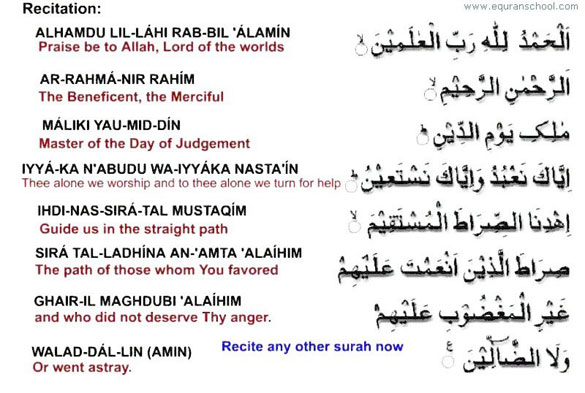
Surah Al- Fateha is called ‘Mother of the Holy Quran', (Ummul Quran). The Arabic word ‘Fateha’ has its root in the word ‘Fatah’ that means 'the opening'. Surah Al-Fateha is the opening verse of the Holy Book, the Quran. The mother verse of the Holy Quran has all the positivities of the divinity that is needed to guide the human being on to the righteous path. It provides a feeling of standing in front of Allah and requesting Him for guidance on the righteous path. Consider the English translation of the Surah to understand its beauty and importance:

All praise is for Allah—Lord of all worlds, the Most Compassionate, Most Merciful, Master of the Day of Judgment. You ˹alone˺ we worship and You ˹alone˺ we ask for help. Guide us along the Straight Path, the Path of those You have blessed—not those You are displeased with, or those who are astray.  — Dr Mustafa Khattab

When we recite Surah Al-Fateha in our Namaz or otherwise, we address Allah, the Almighty as, ‘All praise is for Allah—Lord of all worlds, the Most Compassionate, Most Merciful, Master of the Day of Judgment to invoke His mercy before presenting our supplication.

The next Ayat, ‘You ˹alone˺ we worship and You ˹alone˺ we ask for help’ is our confirmation of His being the only one to whom we ask for help

The Ayat, ‘Guide us along the Straight Path, the Path of those You have blessed—not those You are displeased with, or those who are astray’ is a Dua for guidance on to the righteous path on which He guided all the prophets, the companions of the noble Prophet Muhammad (SAW) and all the Auliya and righteous people.

Thus, the recitation of Surah Al-Fateha opens the door to Allah’s mercies and rewards with the guidance on to the Serat ul Mustaqeem, ‘The path of those upon whom You have bestowed favour…’ (Al-Fateha: 6).

Prophetic Traditions Depicting the Importance of Surah Al-Fateha

As narrated by Hazrat Abu Hurairah (R.A) that the Messenger of Allah (S.A.W.) said: "….... Allah, the Most High said: I have divided the Salat between Myself and My slaves into two halves. Half of it is for Me, and half of it for My slave, and My slave shall have what he asks for. My slave stands and says: All praise is due to Allah, the Lord of All that exists." So Allah, the Most High says: "My slave has expressed his gratitude to Me." He says: "The Merciful, the Beneficent. So he says: "My slave has praised Me." He says Owner of the Day of Reckoning. He says: "My slave has glorified Me. And this is for Me, and between Me and My slave: It is You alone whom we worship and it is You alone from whom we seek aid" until the end of the Surah "This is for My slave and My slave shall have what he asks for." So he says: Guide us to the straight path. The path of those upon whom You have bestowed Your favour, not those with whom is Your wrath, now those who are astray." (Sunan An-Nasai: 910)

Hazrat Abu Hurayrah (R.A) said that the Messenger of Allah (SAW) said: “Al-Hamdulillah is Umm Al-Quran and Umm Al-Kitab (the Mother of the Book) and the seven oft-repeated.” (Tirmidhi: 3124)

It was narrated that Aishah (R.A) said: “I heard the Messenger of Allah (SAW) say: ‘Every prayer in which the Ummul-Kitab (the Mother of the Book) is not recited is deficient.’” (Sunan Ibn Majah: 840)

 It was narrated by Ubada bin As-Samit (R.A) that Allah's Messenger (SAW) said: "Whoever does not recite Al-Fatiha in his prayer, his prayer is invalid." (Sahih Al-Bukhari: 756)

Abu Hurairah (R.A) narrated the Messenger (Pbuh) of Allah saying, “The chapter commencing with “All praises and thanks are due to Allah the Lord of the Worlds” is the Mother of the Quran, the Mother of the Book, the Seven Oft Repeated Verses and the Great Quran.” (Tirmidhi)

Ibn Abbas (R.A) narrated the Messenger of Allah saying,

“While the Messenger of Allah was sitting with Jibril he heard a creaking sound above him. Jibril looked up and said, “This is [the sound of] a gate that has been opened in heaven today and has never been previously opened.” Then an Angel descended through it and came to the Prophet and said, ‘Rejoice in the good news of two lights that have been given to you such as no Prophet before you has been given. [They are] Surah Al-Fatiha and the concluding [two] verses of Surah Al-Baqarah. You will never recite a word from them without being given the blessings they contain.’ “

Anas (R.A) reported the Holy Prophet saying as “Should I not inform you of the most noble and excellent part of the Quran?” He then recited “All praise and thanks are due to Allah, the Lord of the Worlds” (An Nisai)

Surah Al-Fateha for Cure

Prophet Muhammad (SAW) called Surah Al-Fateha with various names, two of them are Ash-Shifa (The Cure) and Ar-Ruqyah, (The Spiritual Cure). The traditions mentioned below are proof of Surah Al-Fateha being a source of cure for illnesses. One who recites this Surah comes under the protection of Allah, the Almighty. Consider Prophet Muhammad Pbuh’s traditions regarding Surah al-Fateha being a source of cure of illnesses:

Abu Sa’id reported that the Messenger of Allah said: “The Opening of the Book is a cure to every poison.” (Ad-Darimi)

Abu Sa’id reported that after he had recited it to cure a person who had been bitten by a scorpion, the Apostle (Pbuh) of God asked him, “…And what made you to know that it was a Ruqyah.” (Bukhari)

It is narrated by Hazrat Abdul-Aziz bin Suhaib (R.A): "Thabit Al-Bunani and I entered upon Anas bin Malik, and Thabit said: 'O Abu Hamzah! I am suffering from an illness. So Anas said: 'Shall I not recite the Ruqyah (one of the names of Surah Al-Fatiha) of the Messenger of Allah over you?' He said: 'Why, yes.' He said: 'O Allah! Lord of mankind, removed the harm, and cure (him). Indeed You are the One Who cures, none cures except you, a cure that leaves no disease.'"  (Tirmidhi: 973)

The universe has many mysteries that are difficult to understand for a common man. There have been people of wisdom and intellect that have tried their best to understand the Holy Quran and tell the people about its magnitude.

And Allah Knows the Best.

-----

Arman Neyazi is a columnist with NewAgeIslam.com.

URL:    https://www.newageislam.com/islam-spiritualism/al-fateha-quran-elixir-divine/d/125170


New Age Islam, Islam Online, Islamic Website, African Muslim News, Arab World News, South Asia News, Indian Muslim News, World Muslim News, Women in Islam, Islamic Feminism, Arab Women, Women In Arab, Islamophobia in America, Muslim Women in West, Islam Women and Feminism

Palestine in War and Chaos


By Mushtaq Ul Haq Ahmad Sikander, New Age Islam

3 August 2021

Numerous Wars and Incursions Have Been Imposed On The Palestinians

Main Points:

1.    Palestine is a contested land among the believers of Semitic religions and Abrahimic Faith.

2.    The Wars and Operations against Palestinians has led to grave human rights violations.

3.    Israel as a country supported by U.S has never been persecuted for its crimes against humanity.

4.    In the aftermath of Operation Cast Lead no IDF soldier was prosecuted for the massacres, intentional killings and atrocities perpetuated on Gazans.

5.    Collective punishment in the form of economic blockade was imposed on the people of Gaza.

-----


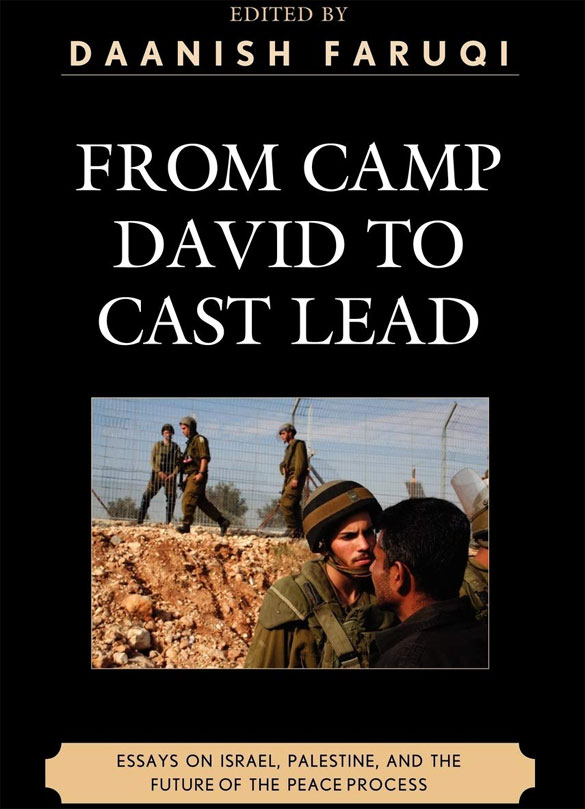
From Camp David To Cast Lead: Essays On Israel, Palestine And The Future Of Peace Process

Edited by Daanish Faruqi

Lexington Books, Maryland, 2011

Pp: 173.ISBN: 978-0-7391-4456-5

------

The issue of Palestine has been on the priority list of United Nations as an unsolved and perpetual dispute since the unjust creation of Israel on 14th May, 1948, the day which is still commemorated as Nakba by the Palestinians. Many wars have been imposed on Palestinians and the neighboring countries by Israel since then, which have consumed thousands of souls, maimed hundreds and destroyed property worth billions. Israel illegally justifies these wars as war for its survival among the hostile Arab Nations. The unconditional and unrelenting support which Israel has been getting from the Super Powers during and after the Cold War has encouraged it to commit more aggression with impunity. Despite the hue and cry by Human Rights activists, United Nations General Assembly resolutions and the bizarre condemnation pouring every other day, Israel isn’t pressurized even by an iota to bring a bit of relaxation in its atrocities against Palestinians.

The present book under review is a compilation of different essays on Israel-Palestine conflict, why Peace is still a casualty, and reconciliation efforts are bringing no respite in violence especially during the last one decade, as the name of the book suggests, the failed negotiations of Camp David(2000) to the Operation Cast Lead(2008-09) edited by a young scholar Daanish Faruqi who in his powerful introduction  to the collection describes that “The idea of a bi-national State shared by Israelis and Palestinians, previously considered sacrilegious in public discourse, is now garnering renewed interest”. Further describing the purpose of the book he writes that, “its purpose is to address the limitations of conventional discourse towards this conflict which the rapidly shifting political dynamics of the past decade have made unabashedly apparent”. This purpose runs through the blood and veins of the book as each essay is a testimony of the same.

The volume has been divided into four sections and the first section Beginnings consists of three chapters. Henry Pachter, in his essay, “Who are the Palestinians?” touches the cord with the history of Palestinians, their agony since creation of Israel and how they become refugees in their own land but infers a unique solution, “The solution for Jerusalem will have to be imposed by great powers; it cannot be negotiated between the parties concerned. As long as they pretend to negotiate about it, they merely indicate that they do not mean to make peace”. (P-17), but whether the imposed solution would be respected by both Israel and Palestine remains a million dollar question and who can guarantee that the imposed solution even if respected wouldn’t initiate a new spate of violence??

“Deconstructing Israeli Democracy: On the cultural pre requisites of Political Modernity” is the title of Michael J Thompson’s paper which deliberates that a liberal democracy as pronounced by John Locke is completely absent in the Israeli politick rather a Jewish hegemony via ethnocentrism which is Pre modern concept and Thompson proves that the presupposition of Uncle Sam and various other countries that Israel is the only country in the Arab World which is a democracy and hence a model to be inspired from and emulated is a brazen sham as, “the very idea of a State defined by religious and ethnic identity becomes anti liberal and therefore anti-democratic since it privileges a conception of politics which survives on the basis of exclusion”(P-22), whereas democracy thrives and survives on pluralism, inclusiveness and mass participation.

Menachem Klein discusses the “Security-Settlement Complex” in the third chapter and unveils the settlement and expansion of Israel in the West Bank, though Gaza is ignored. Klein very well describes how Palestinian land is confiscated and no compensation is paid for the same, and how the nexus of military-settlement-bureaucracy complex tries every tactic to squeeze and suffocate the Palestinian inhabitants of West bank in all aspects. In many cases the military even supports the unauthorized construction and expansion of illegal settlements.

Part second of the book 2000 to 2006: Sharon, the Intifada, and the Roadmap contain four essays which deal with various aspects of Israel-Palestine conflict during these years. Avi Shlaim in his essay, “Ariel Sharon’s War against the Palestinians”, traces the various roles of Ariel Sharon from military to politics and how Sharon was following the Jabotinsky’s way while dealing with Palestinians & Jabotinsky is the father of Jewish right. Sharon was of the firm belief that Palestinians could never be Peace partners; hence it was necessary to decimate and annihilate them wherever you found them, and hence with all the military might at his disposal he expanded the Jewish settlements breaching the Oslo accords. Sharon was a realist, hence power was the deciding factor for his politics and negotiation too, “The Arabs-first the Egyptians, then the Palestinians, then the Jordanians-learnt the hard way that Israel could not be defeated on the battlefield and were compelled to negotiate with it from a position of palpable weakness”(P-44). He tried every tactic to defeat Palestinians and make them negotiate on his own terms. Sharon was the father of the Iron Wall Zionist strategy too and hence the ‘security barrier’ the wall was erected along the West bank.

“The Building of a Wall” is the title of the next essay by Moshe Zuckermann, he takes the reader into the dynamics of the wall debate and will it serve the purpose of curbing the ‘terrorism’ according to Israel, but he concludes that this policy of “shattering terror”, “is nothing other than a perfidious ideology as long as the actual causes of terror, and the now decade-old Israeli occupation and systematic oppression of the Palestinian people, are not abolished”(P-56).

“West Bank Settlements Obstruct Peace: Israel’s Empire State Building” is the title of Marwan Bishara’s essay who believes that the greatest barrier to Peace in the Middle East are the ever expanding Israeli settlements and “the settlement drive and its ideology have become a cornerstone of modern Israeli national identity”(P-59). The settlements have various ramifications on different aspects of life and even the power of settlers is growing in the electoral politics too and the settlers like Uncle Sam believe in ethnic cleansing and targeting innocents under the veil of War on terror, plus the discriminatory laws prevalent between the settlers and Palestinians make Peace an illusion and distant dream.

Mustapha Barghouti’s essay “A Place for our Dream” takes the settlement debate further and writes that, “through its settlement activities, Israel has sought to transform the West bank into ethnically Israeli territory, in which Palestinian villages and towns are nothing more than isolated outposts”(P-65) and he also deliberates on several steps to be undertaken for the restoration of Peace in Palestine.

Part third of the book, 2006 to 2008: Hamas Election Sweep, Gaza Incursions, and the Annapolis Peace Conference contains three essays, starting with Elna Sondergaard’s long essay “Trails in the Israeli-Palestinian Conflict” which lucidly but academically discusses the helplessness of judiciary and the fate of litigations. In case of settlements courts can’t decide or provide judicial protection and usually have to take the official position, thus courts fail to take an independent stance or come to rescue of the wronged ones who are facing the Israeli State’s wrath.

“Blitzkrieg in Gaza’, is the title of Lawrence Davidson’s essay according to whom there have been more than three hundred Israeli incursions into Gaza, West bank and Lebanon since 1967, and this essay has been written in the backdrop of Operation Summer Rains of 2006 which was imposed on Gaza by Israel to recover an abducted soldier and the purpose of the war was to dismantle and dislodge the elected Hamas government. Despite opting for the Peaceful means of resistance, the biased media always stereotypes and reports the suicide bombings by Palestinians only but sidelines the peaceful methods and makes them die in oblivion.

Stephen Eric Bronner, tries to describe “Who are the Palestinians Today?” in his essay and goes back into history when during the Cold War the atrocities and breach of treaties by Israel were overlooked by U.S.A because it was supposed to check the spread of communism in the Arab world, but now when the elected Hamas government is in place, Israel is also being condemned for its violations of treaties and human rights. The various conferences like Annapolis are discussed too which had no outcome, plus the attempts of unity between Hamas and Fateh are discussed too, alongwith the stance of Israel to talk to Hamas only when it recognizes Israel, but till date no such reconciliation attempts have been opted for.

The fourth and the last part Gaza in 2009-2010: Operation Cast Lead and the Future of the Peace Process contains two essays, “Unjust and Illegal: The Israeli attack on Gaza” is the fist essay by Stephen R Shalom, which deals with the Operation Cast Lead when Israel attacked Gaza on the pretext of firing rockets into Israel. Shalom is of the opinion that no self defense theory of Israel is justified as Palestinians are struggling by just means to end occupation. The settlements in occupied territories are illegal, and it is always Israel which breaches every truce and in the pretext of Operation Cast Lead Israel did the same, though Hamas was ready to extend the truce again. There are no means by which Israel can justify the Operation Cast Lead and the atrocities committed against Palestinians were just unheard of, like using Palestinian civilians as human shields, mingling Israeli Defense Forces(IDF) with Israeli civilians, targeting hospitals and ambulances on the charge of harboring militants and acting as their safe havens. In the aftermath of Operation Cast Lead no IDF soldier was prosecuted for the massacres, intentional killings and atrocities perpetuated on Gazans and to add insult to injury collective punishment in the form of economic blockade was imposed on the people of Gaza.

Sara Roy’s essay “Gaza’s Diminishing Landscape” speaks about the agony and devastation which people of Gaza underwent as a result of the Operation cast lead and various other Israeli incursions before, how their lives are ruined by the war and now by the economic blockade which has resulted in a crises of every type in Gaza. Roy is of the opinion that whether settlements are expanding or the Israel is militarily occupying Gaza water, transport, food items, trade, taxes, tourism everything is controlled by Israel, and Roy also tries to highlight the dichotomy between West Bank and Gaza, but is all praises for the spirit of Gazan’s who have started to rebuild their lives once again.

The book is an essential read for everyone interested in the last decade of Israel-Palestine conflict and not even a general reader can afford to miss the book, which contains opinions, analysis and solutions of varied hues. The book lives to its promise which its Editor Daanish Faruqi makes in the Introduction to the volume, “Whether the two state solution is the most desirable outcome is beside the point; instead, the goal of this volume is to challenge the underlying assumptions of prevailing peace paradigms by exposing their limitations in the aftermath of the past ten years”. The book is successful in addressing the challenges and we must congratulate the young editor for compiling this volume which is an important addition to the Israel-Palestine conflict.

-----

M.H.A. Sikander is Writer-Activist based in Srinagar, Kashmir

URL:   https://www.newageislam.com/books-documents/palestine-war-un/d/125169


New Age Islam, Islam Online, Islamic Website, African Muslim News, Arab World News, South Asia News, Indian Muslim News, World Muslim News, Women in Islam, Islamic Feminism, Arab Women, Women In Arab, Islamophobia in America, Muslim Women in West, Islam Women and Feminism