Wednesday, August 12, 2020

World Is Much More Complex Than What Has Been Defined by Deoband, Nadwa And Their Allied Madrasas


By Mushtaq Ul Haq Ahmad Sikander, New Age Islam

12 August 2020


Deeni Madaris: Asri Maanwiyat Aur Jadeed Taqazey

Author: Ebrahim Musa

Translator: Waris Mazhari

Publisher: Maktaba Naimia, Deoband, India

Year of Publication: 2017

Pages: 339   Price: Not mentioned


Madrasas in South Asia have been described as ‘dens of terror’ in the media. This stereotypical image of madrasas still continues to dominate the mainstream media. A number of studies have been conducted about the role and impact of madrasas among Muslims. There certainly are voices that demand a holistic change in madrasas in order to keep them abreast with the current changing times, context and scenario. Till now the madrasas have been resisting such changes and maintaining the status quo particularly pertaining to their curriculum.

The book is an Urdu translation of What is a Madrasa? written by Ebrahim Moosa, Professor of Islamic Studies at Notredam University, United States of America (USA). The translation has been done by a prolific writer and Islamic scholar Dr Waris Mazhari. In his Translators note, Dr Waris writes the problems he had to confront with while translating the text as well as the need for its translation in vernacular Urdu for wider dissemination.

Prof. Moosa terms the book as his complex autobiography and he is correct. This book documents his educational journey in the madrasas of Deoband and Nadwatul Ulama. It is quite interesting to go through his journey as he is grounded in both traditional (madrasa) form of education and contemporary (University) educational system. So events of 9/11 brought madrasas in the focus, that too in a very negative manner. The stereotypical image of madrasas as factories producing terrorists was reinforced by the foreign policy of U.S. Similarly madrasas were quite critical of the imperialistic goals of U.S against the Muslim world. This manufactured image of madrasas still persists but academically it has been established that madrasas certainly do not engage in terrorist activities particularly those based in India.

Prof Moosa is of the opinion that many things that are taught in the madrasas have no application in the modern society. The world is much more complex than what has been defined by Deoband, Nadwa and their allied madrasas. The obsession with certain mundane issues like dress is keeping the madrasas confined to narrow aspects of life. Also, the sectarian staple diet that is included in madrasa curriculum is certainly helping reinforce the sectarian divide among the Muslims in India. This sectarian polemics is then carried out further by the Ulama and theologians who have been trained in this curriculum. The antagonism towards other sects and particularly Mawlana Abul Ala Mawdudi is evident from the curriculum and attitude of teachers both at Deoband and Nadwatul Uloom madrasas.

Prof. Moosa spent six years of his life in madrasas and describes its unique variegates. The life inside a madrasa is quite simple that revolves around studies only. It provides complete boarding, lodging and eating facilities that are free of cost for the students. Madrasa institutions are one of the most well networked educational movements among muslims particularly in South Asia. But due to the irreligious division of the madrasa education between religious and worldly, two strands of knowledge exist parallel among muslims. So it has led to a dichotomy and antagonism among Muslims as each group is leveling charges against the other for the retrogression prevalent among Muslims. There have been demands for introducing new subjects like social sciences and English language in madrasa curriculum but the administrators of madrasas have been resisting such demands as they believe that such steps will render the students to become worldlier and career oriented. Although this apprehension is ill founded but the believers in status quo observe that unlike schools, madrasas emphasize on the holistic development of a personality particularly the character of the students.

The book also engages with the Muslim religious reformers in the subcontinent and books that are included in the curriculum and are part of different disciplines. The question of change in madrasa curriculum known as Dars e Nizami is engaged with time and again. The rate of success of this change is documented too. The need for change in Dars e Nizami has been articulated by traditional Ulama like Manazir Ahsan Gilani and Maulana Yusuf Binori, so it is not a new demand but has met with a very little success. So now madrasas have been rendered as republics of piety instead of being Republic of letters.

The question of madrasas needs to be seriously engaged with. Very few insider and native accounts of the working, education, administration and curriculum of madrasas is available. The media and Islamophobes keep churning out lies about madrasas and their functioning. They allege that Madrasas produce violent and exclusivist Muslims who are a threat to modern societies. The evidence however runs to the contrary. Few Ulama have written their accounts about life in a madrasa but they are available in vernacular languages only with no serious readership available. This book has an added advantage that it has been written in English language only. But the translation was essential too so that madrasa cadres, their ulama and other general readership who cannot read English are acquainted with the narrative and arguments of the book. Hopefully this book makes the madrasa oriented Ulama think afresh particularly about the inclusion of social sciences and English language in madrasas that will make them and their students quite abreast with the modern issues. The Ulama till now have been unsuccessful in tackling the challenges that are being faced by the Muslims and the underlying cause for the same has been the flawed curriculum that has been drafted two centuries back and since then has witnessed very little modification.

Both the author and the translator need to be congratulated for their laudable academic efforts. Hopefully this book will clear many myths related to madrasas.

M.H.A.Sikander is Writer-Activist based in Srinagar, Kashmir

URL:  https://www.newageislam.com/books-and-documents/mushtaq-ul-haq-ahmad-sikander-new-age-islam/world-is-much-more-complex-than-what-has-been-defined-by-deoband-nadwa-and-their-allied-madrasas/d/122607

New Age Islam, Islam Online, Islamic Website, African Muslim News, Arab World News, South Asia News, Indian Muslim News, World Muslim News, Women in Islam, Islamic Feminism, Arab Women, Women In Arab, Islamophobia in America, Muslim Women in West, Islam Women and Feminism

Monday, August 10, 2020

Does Islam Allow Husband and Wife to Spy On Each Other?


By S. Arshad, New Age Islam

08 August 2020

Modern society is a complex society plagued by many social, ethical and psychological ills. People live a busy life and try to fulfil all the personal and societal obligations at the same time.

The hectic life has taken the greatest toll on the relationship between husband and wife. Since in many families, both the spouses do a job to meet the expenses, they find little time to give each other. In many cases, when the husband returns from office, it is time for the wife to leave for her job. This causes between them a trust deficit and overtime they become suspicious of each other's fidelity.


In modern times, in many big cities, a growing number of husbands and wives and also young and unmarried people are resorting to modern technology to spy on their friends and partners to find if they are being cheated or not. In many cases the wife consults a cyber expert to find ways to track her husband's activities, his messages, chats and conversations over the phone. Many IT companies today offer apps that can help the wife keep track of her husband's activities with the help of his phone without giving the husband a hint of his being on surveillance.

Similarly, many men resort to the technology to keep track of the movements and contacts of their wives. And this has become so common that it is not considered immoral and illegal though according to the law, it is illegal to spy on someone without his/her permission.

What does the Quran say about it? The Quran has made it clear that spying on anyone is an intrusion into the privacy of an individual and a violation of a person's human rights. There are a number of verses in Surah Al Hujurat and Surah Al Nur guaranteeing people right to privacy. Surah Al Hujurat (12) says:

O ye who believe! Shun suspicion (Dhann). And lo! some suspicion is crime. And do not spy or backbite each other."

Surah Baqarah (189) says:

"It is not virtue if you enter your houses from the back. It is virtue if you fear Allah. Enter houses through the proper door."

Quran prohibits men from spying on each other and entering their own house from the backdoor to catch the family members unaware. And among the family members, the wife is an important member and in the modern nuclear family structure, the wife is the second most important member after the husband.


In a verse, husband and wife are described as the garment for each other. Therefore, The holy Quran guarantees equal rights to privacy to both the spouses.

The Quran says "Do not spy" and in the modern times, spying has assumed a wide meaning. Today, spying does not merely mean eavesdropping or peeking, or checking the pocket of the husband for any love letter. It means the use of sophisticated technology to track someone round the clock. It includes hidden camera, phone apps or phone tapping devices apart from stealthily checking the spouse's phone or diary. Therefore, the modern Islamic jurists need to define the word 'spying' in the light of the use of technology for spying and the new social and moral issues arising out of the complexities of the contemporary life.

In 2016, the government of UAE took notice of the phenomenon of spying by spouses on each other and in the light of the Quranic injunctions, made a law to criminalise it. It said that checking the phone of the spouse or spying on him or her in any manner was 'haram'. The Grand Mufti at the Islamic Affairs and Charitable Activities Department said that Islam prohibited any kind of activity that came under spying between spouses, between friends, siblings or between two individuals.

Similarly, the government of Saudi Arabia also declared spying on the spouse a crime. Now spying including with the help of (hidden) camera, computer or any other electronic device is a punitive crime and the offenders will be punished with one year imprisonment or a fine of 500 Riyal or both.

Thus, the Islamic countries are waking up to this immoral and unethical practice of spying by the spouses on each other and have dealt with this in the light of Qur'anic injunctions.

The position of the Quran on this is clear. If husband and wife have doubts or differences, they should express them to each other and if they cannot trust each other and cannot sort out the differences, they can mutually end the marriage. Someone rightly said, "if the distrust has risen to such a degree that you have to spy on your spouse, then you should end the relationship instead of staying together like strangers or enemies."

 URL: https://www.newageislam.com/islamic-sharia-laws/s-arshad-new-age-islam/does-islam-allow-husband-and-wife-to-spy-on-each-other/d/122594


New Age Islam, Islam Online, Islamic Website, African Muslim News, Arab World News, South Asia News, Indian Muslim News, World Muslim News, Women in Islam, Islamic Feminism, Arab Women, Women In Arab, Islamophobia in America, Muslim Women in West, Islam Women and Feminism

Saturday, August 8, 2020

Hagia Sophia To A Mosque: Is President Erdogan Guiding Turkey Away from Prophet's Sunnah


By T.O. Shanavas, New Age Islam

08 August 2020


The Church of the Hagia Sophia, or Holy Wisdom, in Istanbul was first built in the year of 350 AD. It is the third church of the Orthodox world after the Church of the Holy Sepulcher in Jerusalem and the Church of the Nativity in Bethlehem. Eleven hundred years after, it was converted into a mosque by Emperor Fatih Sultan Mehmed who invaded Constantinople in 1453. Five hundred years after that, then president of the secular republic of Turkey, Mustafa Kemal Pasha, turned it into a museum, accessible to all. Through all these changes of status, the shrine of the Hagia Sophia has remained in the heart of the Eastern Orthodox Christian world as a site of Christian worship, sanctified by the blood of martyrs. And Hagia Sophia is a UNESCO world heritage site and a global symbol of world history and multicultural representation.


Also Read:  A Nationalist Takeover of Hagia Sophia is not What the Muslim World Needed Now


Why President Erdogan chose to convert church preserved as museum to mosque? Mr. Erdogan’s current political standing after 17 years in power as prime minister and president is shaky, and he needs to feed his nationalist base. Erdogan’s shortsighted, cynical campaign struck at the very heart of world culture and Istanbul’s essential character. This is a dangerous decision of a beleaguered autocrat motivated by a desire to punish Istanbul’s inhabitants, who voted decisively against him, and by a desire to consolidate his position by stirring sectarian animosity between his pious followers and those attached to secular traditions.


Also Read: Hagia Sophia, Religious Tolerance and Nation-States


Some Muslims, including myself, are not cozy with the change of the status of the museum. From many Muslims, it stands out as an unjust and unethical act contrary to Sunnah (the traditions and practices of Prophet Muhammad, peace be upon him). For most Muslims, the religious pluralism of the Quran echoes the protection of “monasteries, churches, synagogues, and mosques in which the name of God is much mentioned.” (22:40.


 The Covenant of Prophet Muhammad with the Monks of Mount Sinai, also called the Ashtiname of Muhammad.  A copy of this document is kept at the Saint Catherine's Monastery.

-----

 Prophet Muhammad(pbuh)’s covenants with Christians unquestionably and absolutely prohibit conversion of churches into mosques. Let me quote the pertinent clauses from the covenants:


“Mahomet sent from God to teach mankind, and declare the Divine Commission in truth, wrote these things. That the cause of Christian religion determined by God, might remain all parts of the East, and of the West, as well amongst the inhabitants, as strangers, near and remote, known, and unknown: to all these people I leave this present writing, as an inviolable league, as a decision of all farther controversies, and a law whereby justice is declared, and strict observance enjoined. Therefore, whosoever of the Moselmans Faith shall neglect to perform these things, and violate this league, and the manner of infidels break it,  and transgress what I command herein, he breaks the Compact of God, resists this agreement, and condemns his Testament, whether he be a King, or any other of the faithful…I promise to defend their judges in my provinces, with my force with my Horse and Foot, Auxiliaries, and other my faithful followers; and to preserve them from their enemies, whether remote or near, and secure them both in peace and war: and to protect their Churches, Temples, Oratories, Monasteries, and places of Pilgrimage wheresoever situated whether in Mountain or Valley,  Cavern or House, a plain, or upon the Sand, or in what sort of edifice so ever: also to preserve their Religion and their goods in what part so ever they are, whether at Land or Sea, East or West, even as I keep myself and my Scepter, and the faithful believers of my own people. Likewise, to receive them into my protection from all harm, vexation, offence, and hurt,…Wherefore I do conjure my people by God and His Prophet to maintain these things, and fulfill them, in what part so ever of the world they are. And the Messenger of God shall recompense them for the same; the perpetual observation of which he seriously recommends to them, until the Day of Judgement, and dissolution of the of the world…”

(Ref: The Covenants of Prophet Muhammad with the Christians of the World. John Andrew Morrow. Pp 227, 229).


There are other similar covenants of Prophet (pbuh) with Persian, Sinai, Najran, and Assyrian Christians. Khalif Umar Ibn Khathab (ra) meticulously self-practiced Prophet (s)’ guidance in dealing with people of other faiths. It is recorded by Abū Jaʿfar Muḥammad ibn Jarīr ibn Yazid al-Ṭabarī (224–310 AH; 839–923 CE) in Ta’rikh al-rusul Wa’l muluk (The History of Al-Tabari). Here are clauses pertinent clauses to the context from the covenant of Umar Ibn Khathab with the Christian Patriarch at the time of surrender of Jerusalem:


“In the name of God, the Merciful, the Compassionate. This is the assurance of safety (aman) which the servant of God, Umar, the Commander of the Faithful, has granted to the people of Jerusalem…Their churches will not be inhabited [(by Muslims] and will not be destroyed. Neither they nor the land on which they stand, nor their cross, nor their property will be damaged. They will not be forcefully converted…’

  (Ref: The History of Tabari, translated by Yohanan Friedmann, Vol.XII, p 191)


It is a well-known fact that Umar Ibn Khattab rejected to pray at Christian church because he feared that later Muslims would convert the church into mosque because Caliph prayed there:


‘Later Muslims express their contempt for the Christian belief by calling the Anastasis al-qumamah (“the Dungheap”) instead of al-quiyamah (“the resurrection”). Umar, however, showed no such chauvinism, even in the excitement of an important military victory. While he was standing beside the tomb, the time for Muslim prayer came around, and Sophronius invited the Caliph to pray where he was. Umar courteously refused: neither would he pray in Constantine’s Martyrium. Instead he went outside and prayed on the steps beside the busy thoroughfare of the Cardo Maximus. He explained to the patriarch that had he prayed inside the Christian shrine, the Muslims would have confiscated them and convert them into an Islamic place of worship to commemorate their Caliph’s prayer in the bayt al-maqdis. Umar immediately wrote a charter forbidding Muslims to pray on the steps of the Martyrium or build mosque there. Later he prayed in the Nea and again, was careful to ensure that it would remain in Christian hand.”

(Ref: Jerusalem One City, Three Faiths. Karen Armstrong. p.229).


The Hagia Sophia is an enormous architectural marvel in Istanbul, Turkey

------

This historical event was reported by British historian H.G. Wells, American historians John W Draper, Will Durant, and others. Umar Ibn Khattab was not only respectful to Christian holy sites but Jewish holy places also:

“For years, the Christians had used the site of ruined Jewish Temple as the city rubbish dump. The Caliph helped his Muslims to clear the garbage with his hands...”

(Ref: Holy War. Karen Armstrong. p.31)


In summary, Turkish decision to convert the Hagia Sophia into mosque is absolutely against the Sunnah (the traditions and practices of Prophet Muhammad, peace be upon him), and is equal to the rejection of Prophet (s). It is still not too late for the Turkish President Erdogan to revoke his shortsighted move to change the Museum into mosque. Currently with its long history in background, the preservation of Hagia Sophia as museum allowing the equal access to people of all faith is the best solution to celebrate religious pluralism of Islam, and also a solution for Erdogan and his Turkish patrons to live by the Sunnah of Prophet Muhammad (pbuh). In a museum environment, some may choose to visit museum for the spiritual comfort and others may be attracted by its architectural or artistic splendor. Whatever may the driving force to visit museum by Muslims and Christians, they are there consumed by the radiant presence of God or for the glorification of God.


Also Read:  Hagia Sophia: Conversion of A World Heritage to A Worship Place for One Community Is an Insensitive Act


Also read:  Convert Hagia Sophia As the Inter- Religious Faith Centre of Peace and Harmony for The Well Being of Humanity


So, I implore President Erdogan to return to the Sunnah of Prophet (pbuh) and restore Hagia Sophia to its Museum status.


[Author of book: “The Islamic Theory of Evolution: The Missing Link between Darwin and The Origin of Species.” Co-author of the book with Prof. Howard J Van Till and Rabbi David Kay : And God Said, “Let There Be Evolution”: Reconciling the Book of Genesis, the Qur’an and the Theory of Evolution, by Prof. Charles M. Wynn of Eastern Connecticut University and Prof. Arthur W. Wiggins of Oakland University (Editors)


URL: https://www.newageislam.com/interfaith-dialogue/to-shanavas-new-age-islam/hagia-sophia-to-a-mosque--is-president-erdogan-guiding-turkey-away-from-prophets-sunnah/d/122582


New Age Islam, Islam Online, Islamic Website, African Muslim News, Arab World News, South Asia News, Indian Muslim News, World Muslim News, Women in Islam, Islamic Feminism, Arab Women, Women In Arab, Islamophobia in America, Muslim Women in West, Islam Women and Feminism

Islamic Revivalism and Indian Ulema: Ideological Narratives and Practical Execution


By Mushtaq Ul Haq Ahmad Sikander

07 August 2020


Ahya e Deen Aur Hindustani Ulama: Nazariyati Tafsir Aur Amli Jad o Jahd (Islamic Revivalism & Indian Ulama: Ideological Narratives and Practical Execution)

Author: Dr Obaidullah Fahad Falahi

Publisher: Al Qalam Publications, Srinagar, Kashmir

Pages: 328 Price: Rs 210


Islamic Revivalist movements have a strong relationship with Indian subcontinent. Both Jamaat e Islami (JeI) and Tablighi Jamaat (TJ) were born, evolved and are still maintaining headquarters in the region. Both JeI and TJ were born before the bloody partition of the subcontinent, have survived these decades and still are vibrant in different parts of the world. These two revivalist movements have a strong influence over the Islamic narrative that is prevalent among Muslim societies today. They have been so influential that the Muslims societies, communities and Islamic movements are divided between those who support their interpretation or those who oppose them. Various attempts have been made to study these movements academically and in a journalistic manner too.

The current book under review by an influential prolific writer and Islamic ideologue Dr Obaidullah Fahad Falahi is an attempt aimed less at understanding these Islamic revivalist movements but more to rebut the critique against them, particularly JeI. Dr Fahad has always been defending the Islamist ideologue and founder of JeI, Mawlana Abul Ala Mawdudi from the critique that has been aimed at his understanding of Islam, its political interpretation and role of JeI in politics. The book is actually a compilation of Dr Fahad’s research papers that he wrote over a period of time.

The roots of Islamic revivalism in Indian subcontinent can be traced back to the Islamic movement of Syed Ahmad Shaheed and Shah Ismail Shaheed, known as Shaheeden movement. It was aimed at establishing an Islamic state as Mughal Empire was witnessing a downfall and Sikh empire under Ranjit Singh was expanding its borders. It failed to achieve its objective. Later on it was to inspire other Islamic movements and Dr Fahad credits that this movement unlike other Islamic revivalist movements strongly emphasized on fighting against Shirk (Associating partners with Allah) and Bid’ah (innovations in religion). Other Islamic movements went soft on them because they believed that unity of Muslims is essential, as Shirk and Bid’ah has become embedded within muslim societies, thus fighting against them will result in shattering of unity (P-14). The Shahedeen movement also did undertake certain social causes like widow remarriage and fought against social evils prevalent among Muslims.

As an Islamist ideologue, politics is central to the understanding of Dr Fahad’s Islamic narrative. So, he writes about the political thought of various Islamic scholars like Hamiduddin Farahi and Syed Sulaiman Nadvi. He also engages with the political thought of various Western political theorists too. Maulana Abul Kalam Azad and his Hizbullah party is the first attempt aimed at Islamic Revivalism in 20th century. He used to express his ideas of Islamic revivalism through his newspapers Al Hilal and Al Balagh. Later Maulana Azad adopted a more inclusive path and continued his political activism with Indian National Congress, so we witness an evolution in his Islamic narrative and moorings.

The centrality of mosque is essential in every Islamic revivalist movement particularly for the TJ. They operate through mosques only and invite Muslims towards observing the rituals of Islam more strictly. TJ is basically a mosque movement only and Dr Fahad has depicted how JeI and TJ had similarity among them particularly their pioneers had similar goals in mind that was helping Muslims gain ascendency and progress. But later on differences among them did crop up that changed many things, aims, goals and working style.

JeI influenced almost every scholar, even those who later became its vociferous critics. Among them two names can be quoted. Maulana Abul Hasan Ali Nadwi better known as Ali Miyan and Maulana Manzoor Noamani, were among the pioneers of JeI who had a madrasa background. They were a part of JeI initially and believed in the program of Maulana Maududi for Islamic Revivalism but later on drifted apart, writing rebuttals of Mawdudi’s understanding of Islam.

Dr Fahad rebuts Ali Miya’s critique of Maududi as being flawed and articulating those old issues about JeI and Maududi that have already been answered and rebutted long back. He is critical of Ali Miya’s association and support of TJ and believes that his critique is biased and prejudiced. So, Ali Miyan who earlier stood for restoring the glory and ascendency of Islam (read Islamic State) and with that purpose in mind he wrote the biography of Syed Ahmad Shaheed and his Shahdeen movement. But later he changed his stance due to reasons that Dr Fahad ignores to engage with. Can the reasons be traced to partition that had made Indian Muslims confront new problems that needed giving up the cause of establishing an Islamic State? This pertinent question is not answered by Dr Fahad. Now it has been firmly established fact that JeI, Indian chapter has accepted the Indian model of secularism and democracy while changing its aim of Hukumat e Ilahia (Islamic State) to Iqamat e Deen (Establishing principles of religion). Similarly the critique of Maududi as articulated by Maulana Manzoor Noamani has been far from being correct according to Dr Fahad. It also briefly deals with the critique of Maulana Wahiduddin Khan, who was among the first Ulama’s to rebut Marlana Mawdudi’s interpretation of Islam. Maulana Khan describes the interpretation as Tabeer ki Galati (Error in Interpretation) and his critique is yet to be rebutted or critically engaged with by any Islamist ideologue particularly of JeI.

This book leaves much scope for intellectual engagement particularly with Islamic Revivalist movement, but certainly is has a plethora of information that point out to the wide scope of Dr Fahad’s vociferous reading and understanding of the subject. He has engaged with the critics of Islamic revivalist ideology and certainly this book deserves to be read and its arguments engaged with. But it certainly does not answer the flaws and problems that JeI still is witnessing and how a similar ideology is operating in variegated forms in India, Pakistan, Bangladesh and Kashmir. 

M.H.A.Sikander is Writer-Activist based in Srinagar, Kashmir

URL:  https://www.newageislam.com/books-and-documents/mushtaq-ul-haq-ahmad-sikander/islamic-revivalism-and-indian-ulema-ideological-narratives-and-practical-execution/d/122581

New Age Islam, Islam Online, Islamic Website, African Muslim News, Arab World News, South Asia News, Indian Muslim News, World Muslim News, Women in Islam, Islamic Feminism, Arab Women, Women In Arab, Islamophobia in America, Muslim Women in West, Islam Women and Feminism

Friday, August 7, 2020

How Those Indian Muslims Who Support Erdogan On the Hagia Sophia, Oppose Modi On Ram Mandir?


By Feroze Mithiborwala, New Age Islam

August 6, 2020

It boggles my mind, astonished to observe as to how those Indian Muslims who support Erdogan on the Hagia Sophia, oppose Modi on Ram Mandir? How do you oppose a Hindu Rashtra here, whilst welcoming Islamic states abroad, where Muslims are in a majority? Thus it is often said that, where Muslims are in a minority they demand & support a secular state & where in a majority demand an Islamic state, whilst also stating that modern secularism is un-Islamic.


Dressed in a traditional silk dhoti and gold-coloured kurta, Modi offered prayers to the infant deity, Ram Lalla, at the makeshift temple and performed a circumambulation, before planting a sapling (ANI Photo)

-----

How do you oppose the Hinduisation of our education, culture & society even as you yourself, promote & welcome Islamisation in all its facets?

How do you support an Islamic supremacist & extremist like Zakir Naik, who publicly affirms that all non-Muslims, however good they may be will go to hell? Naik has also publicly stated that in an Islamic State, Hindus & Christians can only worship from the privacy of their homes and have no right to build Temples & Churches. That in an Islamic State, only Islam will have the sole right to practise, preach & proselytize, whilst the others can only practise, that too under restrictions. Yet Zakir Naik has a large “fan” following. Can’t we see that something is terribly wrong here? Something truly worrisome?

All this whilst bemoaning the demise of Indian secularism, multi-culturalism & our diverse liberal plural society. Can’t you see how hypocritical we appear to the rest of Indian society? Do you understand how much damage your hypocrisy & double standards have caused over the decades?


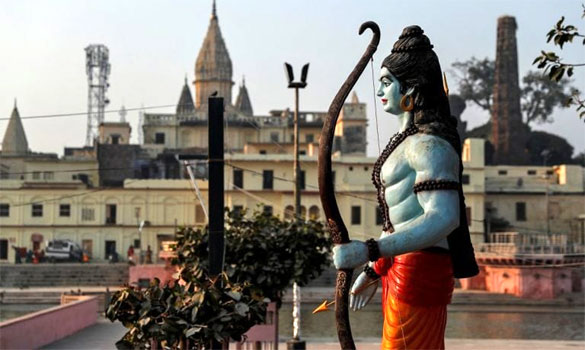
Ayodhya is decked up for the 'bhoomi pujan' on Wednesday that will be attended at the Ram Janmabhoomi by 175 people, who figure in a select guest list of seers and politicians topped by Prime Minister Narendra Modi./ Photo CNBC News 18

-----

Undoubtedly many factors have contributed to the rise of Hindutva Fascism, but the hypocrisy of the Indian Muslim conservative/Islamist right-wing is one of the key ingredients in that volatile mix.

The defining moment was clearly the Shah Bano judgement, where the majority of the Ulema & conservative sections were adamant in their refusal to accept gender just reforms and equal citizenship rights as guaranteed by the Indian Constitution. The mobilisation by the Muslim right, provided the catalyst, the spark to the Hindu right. The rest is history that finally culminated in the destruction of the Babri Masjid & spurred the movement for the construction of the Ram Mandir & brought the BJP into power.

It’s high time that both the Indian Muslim community and the secular, progressive sections accept this reality and debate the issue publicly. For India to move ahead on the path of a liberal, secular, parliamentary, an egalitarian constitutional democracy, we will have to confront this issue and arrive at honest answers. The earlier we do the better.

Feroze Mithiborwala is a social activist

Original Headline: The Day After – A few questions for Indian Muslims to ponder over

URL : https://www.newageislam.com/islamic-society/feroze-mithiborwala-new-age-islam/how-those-indian-muslims-who-support-erdogan-on-the-hagia-sophia-oppose-modi-on-ram-mandir/d/122571