Friday, August 7, 2020

The Term 'Hindu Bania' Used by Pakistani Columnists and Writers Speaks of Their Sick Mentality


By S. Arshad

07 August 2020

Islam asks believers to never shun justice or moral decency even while dealing with enemies. But when we read the Urdu newspapers of Pakistan, we regularly observe this lack of moral decency among the writers, so-called intellectuals and columnists reflected in their writings. Most of the columnists do not find any other issue pertaining to social, political, economic and other issues of national importance.

They often write what India is going to do against Pakistan or what conspiracies it is hatching against Pakistan.


Every journalist seems to love to mention RAW as if they have breakfast with RAW officers every morning whereas the fact is that they are ill-informed people with half-baked knowledge of the social, economic and political realities of their own country. They thrive on anti-India paranoia and regularly spew venom against Hindus of India while claiming to be sympathisers of Hindus of Pakistan. While speaking about Hindus, they add the prefix 'bania'.

So, to them, every Hindu is a bania, a derogatory word meaning a cunning businessman. They have coined this term to express their hate against the Hindus of India. I have observed that even journalists and poetesses of Pakistan who occasionally visit India and while in India, praise the Hindus of India and the country's multicultural traditions, use the word Hindi bania in their writings back home as an old habit.

No Hindi newspaper columnist of India uses any derogatory term for Muslims in his writings. The speech or writing of a person only reflects the collective way of thinking of the society or environment in which he lives.

They do it because it is necessary for them to cash in on the popular sentiments. On the other hand, they do not have the courage to write anything about the Taliban, the Lashkar-e-Taiba, ISIS and other terrorist organisations thriving and causing bloodshed in the country because they know the repercussions.

By going through the Urdu newspapers of Pakistan, one will think that terrorism is not an issue of Pakistan. No Urdu columnist dares to write on terrorism as an issue, because they will have to mention the terrorist organisations active in the country.

For example, when one learned columnist of Pakistan wrote an article on Maulana Sarfaraz Hussain Nayeem who had launched a nationwide campaign against the Taliban and was ultimately killed by Taliban, the columnist did not mention a word about Taliban or Maulana Nayeemi's campaign against terrorism and Taliban. The columnist simply praised his simplicity, his contribution to the field of education and his piety.

This is the degree of fear they have of the terrorist organisations of Pakistan. So, what is left for them to discuss? India and Hindus, of course.

They cannot abuse Chini 'bania' because China has instructed their Prime Minister to stop spread of negative propaganda against its inhuman treatment of Uighur Muslims among Pakistani Muslims. For Imran Khan, even a cricket match with India is a jihad.

This is the reason; the Pakistani columnists have to fall back upon India and Hindus to earn their bread and butter and maintain their image as journalists and intellectuals.

S. Arshad is a regular columnist for NewAgeIslam.com

URL: https://www.newageislam.com/islamic-society/s-arshad/the-term-hindu-bania-used-by-pakistani-columnists-and-writers-speaks-of-their-sick-mentality/d/122570

New Age Islam, Islam Online, Islamic Website, African Muslim News, Arab World News, South Asia News, Indian Muslim News, World Muslim News, Women in Islam, Islamic Feminism, Arab Women, Women In Arab, Islamophobia in America, Muslim Women in West, Islam Women and Feminism

Wednesday, August 5, 2020

Turning of Hagia Sophia To A Mosque Has Two Dimensions, Losing Popularity Of Erdogan And Impact Of Global Rise Of Fundamentalism


By Ram Puniyani for New Age Islam

05 August 2020

Last three decades have seen a drastic shift in the global political scenario. Earlier decades were marked by national liberation struggles; focus on the issues related to ‘this World’. Many a countries who came out from the grip of colonialism, under different banners gave primacy to industrialisation, education and agricultural growth. India, Vietnam, Cuba being some of those, which despite the remnants of fundamentalists, marched towards the states upholding the concerns of the struggling and deprived people of the countries, away from the stifling grip of politics in the name of religion. Of course, there were some of the countries where the rulers allied with the clergy to keep alive the feudal norms, perpetuating the grip of backwardness. These had sectarian approach to their policies. Our two neighbours Pakistan and Myanmar do fall in this category.


From the decade of 1980s many factors contributed to the retreat of secular democratic forces and politics wearing the clothes of religion marched trampling the inclusive ethos, marginalising the welfare policies and giving a go by to development and progress as far as industrialisation and education is concerned. Last three decades in particular has seen the increasing hegemony of politics in the name of religion. Terminologies like Islamism, Hindutva, Christian fundamentalism, Buddhist fundamentalism have come to the fore, becoming more assertive and taking these countries down from the path development and worsening the lot of large sections of society.

Also Read:  A Nationalist Takeover of Hagia Sophia is not What the Muslim World Needed Now

Currently in US, Donald Trump is making subtle and overt appeal in the name of Christianity and Ashin Wirathu in Myanmar has been promoting violence in the name of Buddhism. Similar is the phenomena in Sri Lanka, where Wirathu’s clones are on the ascendance. In India the Hindutva has made massive strides. In Afghanistan, Al Qaeda Taliban has tormented West and Central Asia apart from Afghanistan itself. The most blatant expressions of these have been the mutilation of the idols of Lord Gautama Buddha in Afghanistan.  Similarly, demolition of Babri Mosque in Ayodhya is a painful chapter which was used as springboard by Hindu nationalists.


These are just visible symbols, while the socio-economic impact has been dangerously retrograde, the status of rights as citizens, rights of minorities have suffered a severe setback at the same time. This does reflect the direction of global trend. Many slogans have been dominating the scene. Earlier the major propaganda from imperialist forces was ‘Free World versus authoritarian system (socialism)’, later in the aftermath of 9/11 the ruling phrase has been ‘Islamic terrorism’. Currently different fundamentalisms are ruling the roost, stifling the democratic ethos and undermining human rights in general.

It is in this background that conversion of Hagia Sophia from a museum to Mosque can be understood. Turkey was one of the major countries which under the leadership of Kemal Ataturk had embraced the path of secularism, overthrowing the Caliphate the carryover of Ottoman Empire. This Caliphate even had some approval from section of global Muslim community. Ataturk had unshakable commitment to secularism and Hagia Sophia, which initially was a Church and changed to a mosque in 15th Century was converted to a Museum, a space for all with equal and due respect. Erdogan, who has been at the forefront of power from last many years; has been gradually shifting to Islamism. Islamism is to Islam what Hindutva is to Hinduism or Christian fundamentalism is to Christianity. Erdogan rose in the power hierarchy from the competent mayor of Istanbul to later become Prime Minister of Turkey. After the initial years where he could deliver on economic front, he slipped into self-adulation and power hunger kept him shifting the ulcrum of politics towards Islamic identity. The downslide in the condition of the citizens was pathetic and it also got reflected in Erdogan losing the local body elections.


@MiddleEastMnt/ Israel converts historical mosque into a bar and events hall

-----

This is when his turn to Islamism has become more overt and this grand structure of Istanbul, more or less the most important architectural symbol of Turkey, was converted in to a mosque. Sections of Muslims are celebrating this as ‘victory of Islam’. Other Muslims more committed to values and humanism of Islam; are severely critical of this move of Erdogan. They point out that there is no compulsion in Islam in matters of religion. (To you your religion, to me mines). This is in contrast to the popular belief that in India Islam spread on the point of sword.

These serious scholars of Islam also remind us that, at one point of time Prophet Mohammad even invited non-Muslims to the mosque to offer their prayers. Of course, each religion has multiple sub sects and multiple philosophies associated with each. Islam has the range of Shia, Sunni, Khoja, Bohra and Sufi with various legal streams like Hanafi, Hannabali etc. Christians, do have Catholics with few sub streams and Protestants again with many streams. Each claim to be the ‘real’ one. While perhaps what is real in the religions is the love and compassion for fellow human beings. Some aspects of religions are just a cover for lust of power. So we also see that some will approve Jihad, others will defend Crusades and yet another will uphold Dharm Yudh.

The turning of Hagia Sophia to a mosque has two dimensions, one of the losing popularity of Erdogan so resorting to populism of religion as a crutch to hold to power, and other is the impact of global rise of fundamentalism in many a countries. In 1920s Kemal Ataturk could take on the mighty institutions of ‘religion’ to introduce the secular policies on solid secular foundations. In turn of events during last many decades the fundamentalism has hit back. The main reasons have been the role of America in propping up Al Qaeda to counter the Russian army in Afghanistan and later decline of Soviet Union leading to emergence of America as sole super power for some time. America did proactively promote fundamentalism at multiple places. That set the ball rolling and gradual occupation of secular space by the language of religion. What we are witnessing in Turkey is yet example of this retrograde phenomenon. 

Related Articles:

Convert Hagia Sophia As the Inter- Religious Faith Centre of Peace and Harmony for The Well Being of Humanity

Hagia Sophia: Conversion of A World Heritage to A Worship Place for One Community Is an Insensitive Act

URL: https://www.newageislam.com/islam-and-politics/turning-of-hagia-sophia-to-a-mosque-has-two-dimensions-losing-popularity-of-erdogan-and-impact-of-global-rise-of-fundamentalism/d/122551

New Age Islam, Islam Online, Islamic Website, African Muslim News, Arab World News, South Asia News, Indian Muslim News, World Muslim News, Women in Islam, Islamic Feminism, Arab Women, Women In Arab, Islamophobia in America, Muslim Women in West, Islam Women and Feminism

Ram Mandir Inauguration: Why India Was Not Made Hindu In A Day

By Arshad Alam, New Age Islam

05 August 2020


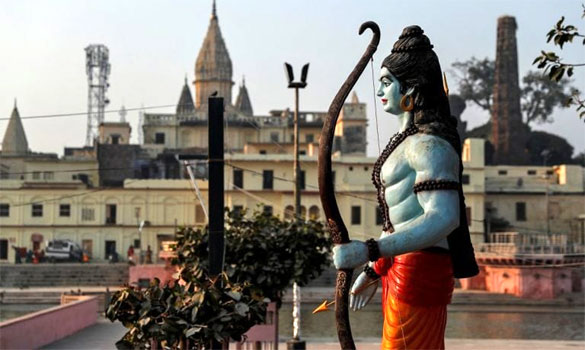
Ayodhya is decked up for the 'bhoomi pujan' on Wednesday that will be attended at the Ram Janmabhoomi by 175 people, who figure in a select guest list of seers and politicians topped by Prime Minister Narendra Modi./ Photo CNBC News 18

-----

It is downright foolish to believe that the 5th of August, marking the beginning of the Ram Mandir construction in Ayodhya, will be marked in the annals of Indian history as the birth of a new republic founded on Hindu majoritarianism. Today is not the day of writing the obituary of nominal Indian secularism. Today is the day to remember that this new republic has been many years in the making. That it is a culmination of a national desire in which all of us have contributed in our own special ways. Today is not just the triumph of nationalist Hindus alone but also those secular forces who secretly wanted this to happen but could not say so openly. Today is the day to remember that you can have hours of analysis on ‘progressive’ national channels without the word Babri mosque and its demolition being mentioned even once. Today is the day to understand why the likes of Rajdeep Sardesai wilfully forget that the temple movement was built on the lives of hundreds of innocent lives. Today is the time to remember that India was not made Hindu in a day.


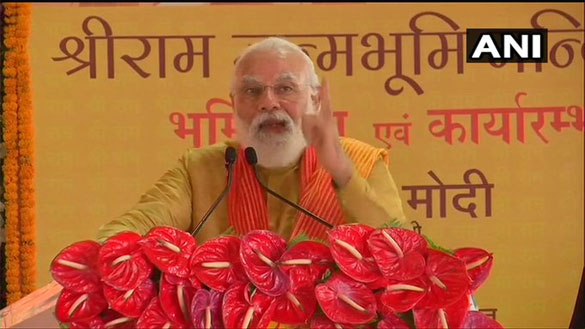
#RamMandir will become the modern symbol of our traditions. It'll become a symbol of our devotion, our national sentiment. This temple will also symbolise the power of collective resolution of crores of people. It will keep inspiring the future generations: PM Modi in #Ayodhya/ ANI Twitter Handle

-----

Today is the day to understand why so many in the so-called secular Congress party are saluting this historic moment by trying to leverage their Hindu identity. They are right in reminding us that they played a very important role in bringing this nationalist juggernaut to its culmination. Priyanka Gandhi Vadra may be a very different person from Rajiv Gandhi but what unites them is their clinical desire to be identified as Hindus who support the temple. It was Indira Gandhi who inaugurated this phase of majoritarian consolidation, first by targeting Muslims in a series of riots during the 1980s and later by targeting the Sikhs in a similar fashion. Let us not forget that she was called a Durga, not for eradicating poverty or illiteracy, but for dismembering Pakistan, a euphemism for external and internal enemy. Supremely confident of her Hindu vote, she would declare that if Muslims were unhappy over the creation of Bangladesh, then she did not need their votes. Her son Rajiv Gandhi continued this majoritarian consolidation by opening the locks of the Babri mosque, allowing shilanyas, and starting his election campaign from Ayodhya. Let us also not forget that when the mosque was being demolished, we still had a secular Congress prime minister who was busy composing erotic poetry. There are many Kamal Naths and Digvijay Singhs within this party for whom secularism meant visiting Muslim shrines only during the time of elections.


Today is also the day to remember the many parties of social justice that emerged to change the existing asymmetry of power and privileges. Their revolution ended with empowering their own castes and ultimately their own families. The effect of years of affirmative action produced a class within these castes whose aspirations became more national than regional. Having a national aspiration today is to gel neatly with the existing majoritarian discourse and this is what these classes did. It is no surprise, therefore, that all such parties, which rose to power partly as a result of Muslim votes, are today silent. Because of the myopic politics of these parties, their social base today identifies more with the Hindu cause rather than with any anti-caste transformative political agenda.


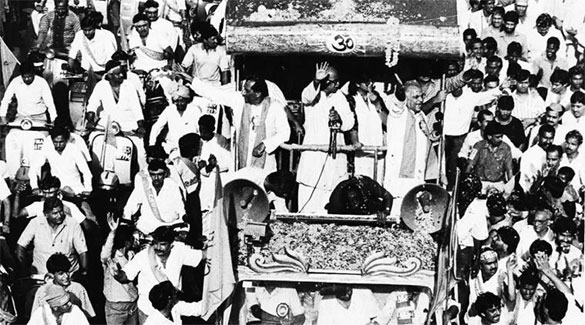
Advani’s rath yatra was the most important milestone in the BJP’s political journey. (Express Archive)

------

Today is the day when we should also remember the original revolutionaries of India, the communists. At the time of the temple movement, they were much bigger parties and had a say in national politics. And yet, not one of these parties saw it fit to launch a counter mobilization to challenge what they themselves claimed was politics of divisiveness and communalism. High on oratory but low on delivery, these parties were similarly afraid of losing their social support by appearing insensitive to the Hindu cause.

Today is the day to understand that there always existed a Hindu national consensus in favour of a Ram temple at Ayodhya. Any other analysis fails to tell us why there was no resistance to this movement. The secular and the so-called communal have all participated in bringing this movement to fruition. World over, nations are constructed by majorities and India is no exception. Today is the day when this reality should dawn on one and all. Today is the day when we see the chimera of secularism for what it really was.

A momentous event, seeped in criminality and bloodshed is bound to affect everyone. But everyone will not be affected in the same way. There are many Hindus who do not identify with what is happening in their names. And yet they will never understand the Muslim experience, their angst and inner tumult, how their very hexis has been scorched by this movement. For Muslims, this is not a matter for some abstract constitutional principle, but a question of their very survival with respect and dignity. The unprecedented inner loneliness has gripped Muslims, something others can understand but can never feel the same way.     

Today is not the day when Muslims should ruminate over the loss of a benign and multicultural state because it was perhaps never there in the first place. Today is the day when they realise when they are all alone; that all attempts at creating marginal solidarities will fail because the very margins have shifted. It is they, and they alone who have to confront this new situation. Today is the day when they should re-assess their location within this changed political firmament, learn from their past mistakes and search for a new grammar of self-preservation. Ram is the first to be armed politically against them but he may not be the last; there are others whose instrumental value can be put to similar use. In a land where there is no dearth of Muslim symbols, Hindu nationalism will necessarily be directed against them. Muslims have to learn to live with the very real possibility that no matter how hard they try, they will always remain the other in this national imaginary. Today is the day to remember that.

Arshad Alam is a NewAgeIslam.com columnist.

URL:  https://www.newageislam.com/interfaith-dialogue/arshad-alam-new-age-islam/ram-mandir-inauguration-why-india-was-not-made-hindu-in-a-day/d/122546

New Age Islam, Islam Online, Islamic Website, African Muslim News, Arab World News, South Asia News, Indian Muslim News, World Muslim News, Women in Islam, Islamic Feminism, Arab Women, Women In Arab, Islamophobia in America, Muslim Women in West, Islam Women and Feminism

Monday, August 3, 2020

Muslims Should Consider the Essence of Sacrifice Rather Than the Ritual at Eid ul Azha

By Dr. Mike Ghouse, New Age Islam
03 August 2020
On Friday, July 31, 2020, over a billion and a half Muslims around the world, will be slaughtering millions of goats, camels, and cattle to carry out Abraham's tradition of sacrificing the symbolic lamb.
 
Abraham_Standing_Next_to_Altar_Of_Sacrifice_001.jpg‎ (434 × 500 pixels, file size: 76 KB, MIME type: image/jpeg)
-----
Is there an alternative to the ritual of slaying animals on Eid Al-Adha, the festival of sacrifice? The answer is yes!
Rituals are the pathways to accomplish milestones of peace for oneself and with what surrounds one; life and environment. None of us can escape from the ceremonies. Each of us instinctively follows certain routines, from waking up to the time we go to sleep. Whether we shower, eat breakfast, go to the office, or gym, we follow the rituals.
 
Prophet Abraham sacrificing Photo / author
-----
The essence of Islam is to create cohesive societies where every human feels secure about his/her faith, race, religion, region, or ethnicity. It is time for Muslims to consider the essence of sacrifice rather than the ritual itself.
Real sacrifice requires us to give up some of what is dear to us. It is about parents going to sleep without food but feeding their kids; it is clothing their kids while waiting to get their own. In the case of extremities, we would instead get the bullet and save our loved ones, we are willing to rescue an individual from a freezing lake risking our own lives, and even strangers do that. 
A thousand years ago, a man's assets were made up of his goats, camels, and cattle. The ultimate sacrifice one would make was to give away his precious assets in gifts. Today, the most cherished possession is money, and people must be willing to part some of it to give the ability to the receiver to spend on his/her critical needs.
One of the examples set up for guidance was the test of Abraham's faith, love, and devotion to God, which humans do routinely, "If you love me, you would do this for me." A simple assurance would suffice, be it your fiancé, spouse, kids, siblings, or parents.
 

It was Abraham's turn to face the command of God to sacrifice his son. Upon hearing this, he prepared to submit to God's will and places his son on the block. Right at that moment, a lamb appears as an alternative. Then God revealed to Abraham that his "sacrifice" has already been fulfilled.
Does God Want Animals to Be Sacrificed?
Not at all. Qur'an, Al-Hajj 22:37 (The Pilgrimage) is clear: "Never does their flesh reach God, and neither their blood. It is only your God-consciousness that reaches Him. It is to this end that we have made them subservient to your needs so that you might glorify God for all the guidance with which He has graced you. And give thou this glad tiding unto the doers of good."
 The act symbolizes our willingness to give up a part of our bounties to strengthen and preserve the web of the universe and help those in need. We recognize that all blessings come from God, and we should open our hearts and share with others. 
What Would You Sacrifice Instead?
It is customary for Muslims to sacrifice an animal on the day of the Hajj, a symbolic representation of Prophet Abraham's act. What are our alternatives? 
We can put that money to a different use that will do greater good like lending to a street hawker who can sell things from a cart and take care of his family or a single mom who can weave baskets or make sweaters to take care of her family. The beauty of this practice is you can make the same money repeatedly work for the common good. Muslims call it Sadaq-e-Jariah, which is continual giving.
Dr. Nauman Anwar: "Sacrificing animals without making a public spectacle is still a good idea, as long as no wastage of the meat and hides occur. Many Muslim countries have a lot of poverty, and if the meat reaches the deserving population, it will help improve the nutritional status of the poor.
Let your single sacrifice multiply rather than the one-time sacrifice of animals. Prophet Muhammad had emphasized service to fellow humans as the highest service to God. Quran (4:152) says, if you are kind to your fellow humans, which is my creation, you will earn my grace regardless of your faith.
Honouring Police, Firemen, And Soldiers
Every day our police officers and firemen risk their own lives to protect ours, our freedom is protected by our men and women in the uniforms. I urge fellow Muslims to stop and salute every one of these men and women, honouring them for their love for humanity. Better yet, call the firemen, policemen, and let them know that as a Muslim you appreciate their sacrifice, and this festival is about appreciation for such sacrifice.
I did that in Louisville; within minutes, the officer had emailed the article to his fellow officers, appreciating the Muslims.
Prophet Muhammad (pbuh) had said the least you can do as a charity is to smile and appreciate the otherness of the others.
You can wish your Muslim friends by saying, Eid Mubarak, Eid Saeed, Happy Eid, Happy Festivities, etc.
Dr. Mike Ghouse is the founder and president of the Center for Pluralism. He is a speaker, thinker, author, community consultant, pluralist, activist, newsmaker, and an interfaith wedding officiant. Mike is deeply committed to Free speech, Human Rights, and Pluralism in Religion, Politics, Societies, and the workplace. His latest book, the “American Muslim Agenda” is available on Amazon, Kindle, and the bookstores. He has dedicated his life to building cohesive societies and offers pluralistic solutions to the media and the policymakers. More about him at www.TheGhousediary.com.
Original Headline: Should Muslims sacrifice cattle on Eid-al-Adha?

Friday, July 31, 2020

The Murder of a Self-Declared Prophet in Peshawar: Why Pakistan Must Repeal Its Blasphemy Laws


By Arshad Alam, New Age Islam
31 July 2020


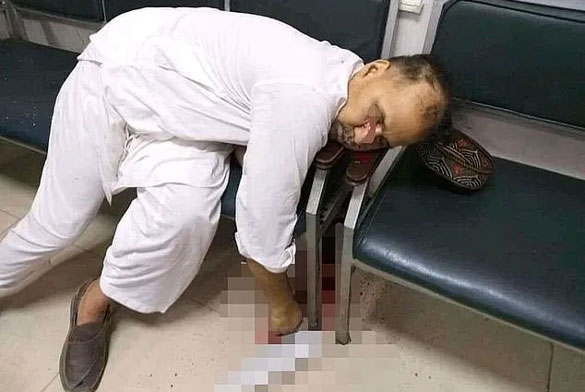
A man accused of blasphemy and facing trial for the last two years, was shot dead right in front of the judge inside a court room in Peshawar. Tahir Shamim Ahmad thought that he was a Masih and that God spoke to him in his dreams. He also proclaimed himself to be the Mujaddid who had come to warn people that the end times was near.
 
Tahir Shamim Ahmad, had claimed he was Islam's prophet
----
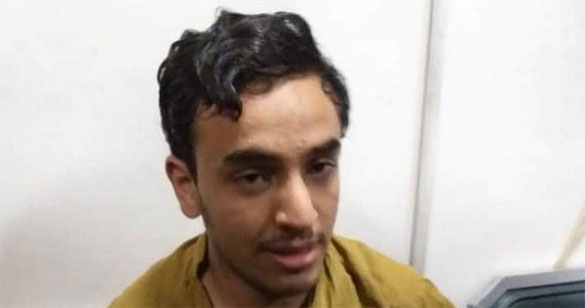
The killer, Khalid, immediately surrendered and declared that had killed the man because he (Naseem) had dishonoured Prophet Muhammad. He added that Islam demanded that such a person should be killed and that he was just following the demands of his religion. Ahmad Naseem was an Ahmadi Muslim, a religious group which has been targeted by Pakistani state and people for many decades now. Blasphemy laws in Pakistan are punishable by death but so far, the courts have refrained from sending any of the accused to the gallows. Currently, there are at least 17 people who are convicted of blasphemy who are on death row.
 
Assailant Khalid Khan
-----
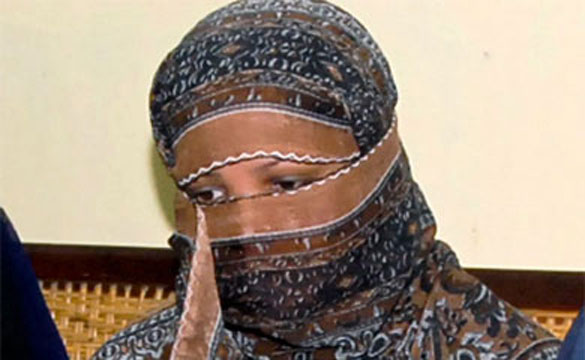
The law is so harsh that anyone accused of the ‘crime’ can ever hope for an impartial trial. Asia Bibi, a Christian woman accused of blasphemy, saw her death sentence overturned only after a prolonged international campaign. Those who spoke in her favour, governor Salman Taseer and minister Shahbaz Bhatti, were accused of being blasphemers themselves and were eventually killed for this reason by the lovers of the prophet. But if the law is adequately harsh, then why the need to kill such ‘blasphemers’ even before a guilty verdict has been pronounced? Videos circulating on the social media suggest that ordinary religious Pakistani Muslims have become wary of the courts. They think that the court takes too much time in delivering any verdict and are suspicious that the many human rights organizations working for the accused may put pressure on the courts.
 
Asia Bibi, a Christian woman
------
 
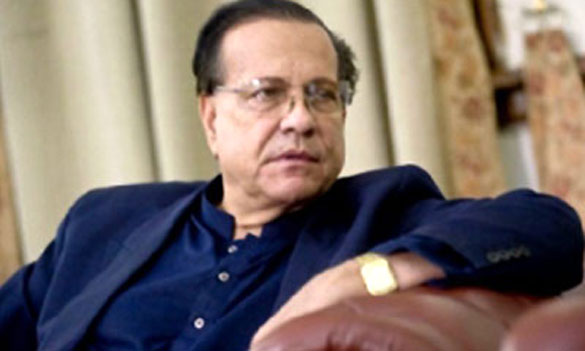
Governor Salman Taseer
----
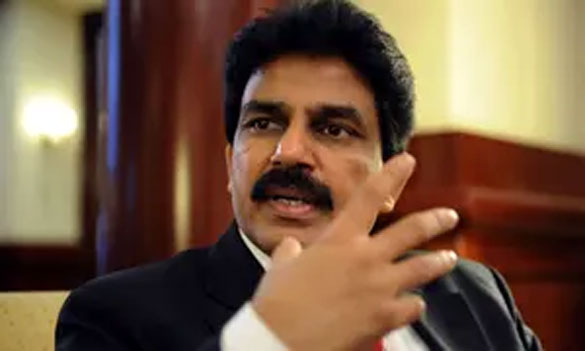
Pakistan Christian Minister Shahbaz Bhatti
-----
Many think that rather than wasting time in courts, it is better that the accused is killed by people instantly. Many Muslims tend to believe that this is enjoined on them by their religion. It is not a surprise therefore that since 1990, as many as 62 people have been killed by religious vigilantes in Pakistan, according to the think tank Centre for Research and Security Studies. 
One can certainly accuse the Pakistan state for having such a tough and harsh blasphemy law and demand that the law either be diluted or altogether scrapped. However, the problem is much deeper. The Muslim society in Pakistan has now come to believe that killing an alleged blasphemer is tantamount to an Islamic virtue. An entire social ecosystem has developed within Pakistan where men who kill a ‘blasphemer’ are feted as ghazi. The killer of Salman Taseer today has the status of a Pir, who can give blessings and cure diseases. His grave is venerated by thousands. Such reverence for a murderer is only possible if people genuinely believe in the necessity and truthfulness of killing a blasphemer. In other words, such killings are considered legitimate and even expected of Muslims. It is this social support which emboldens the political class to defend blasphemy laws. Till the time we do not question this sentiment, we are not going to get rid of this problem.
Does the Quran mandate any such punishment for blasphemy? Certainly not. While it does not tolerate criticism of Islam, God or the Prophets, Quran categorically leaves the job of punishing such individuals in the hands of Allah. In other words, this is something between the concerned person and God which will be judged in the hereafter and not in this world. It seems that the mullahs and muftis have arrogated to themselves the power which should rightfully belong to the Almighty. Interestingly, Muslims who argue that their religion should not be criticised often indulge in criticising other religious traditions, completely forgetting that the Quran forbids them to do so. Thus whereas they freely indulge in lampooning other religions, any criticism of Islam becomes an issue of blasphemy for Muslims. Laws which inhibit free expression of thought is therefore not about respecting all belief systems but only a tool to harass and intimidate the minority.
A democratic country should have no blasphemy related laws as it directly impacts on freedom of expression of its citizens. What characterises blasphemy is a slippery domain and therefore those who are in the business of discussing ideas have no other option but to censor themselves. Such a state of affairs is hardly conducive to the intellectual growth of any country. Rather than promoting religious tolerance, such laws in fact weaken reform minded moderate Muslims and silence minorities, encouraging violence against them. It is not surprising that the majority of those who have been accused of blasphemy in Pakistan are either Shias or Ahmadis, both minorities in their own ways.
Pakistan is trying hard to shed its image as a country which is hostile to its minority population. The renovation and maintenance of Hindu temples and Sikh gurudwaras are all part of this effort to project a tolerant and multicultural image to the outside world. But till the time it has such obnoxious laws on its statute books, the world at large will not believe that Pakistan is making a sincere effort in that direction.
Arshad Alam is a NewAgeIslam.com columnist.